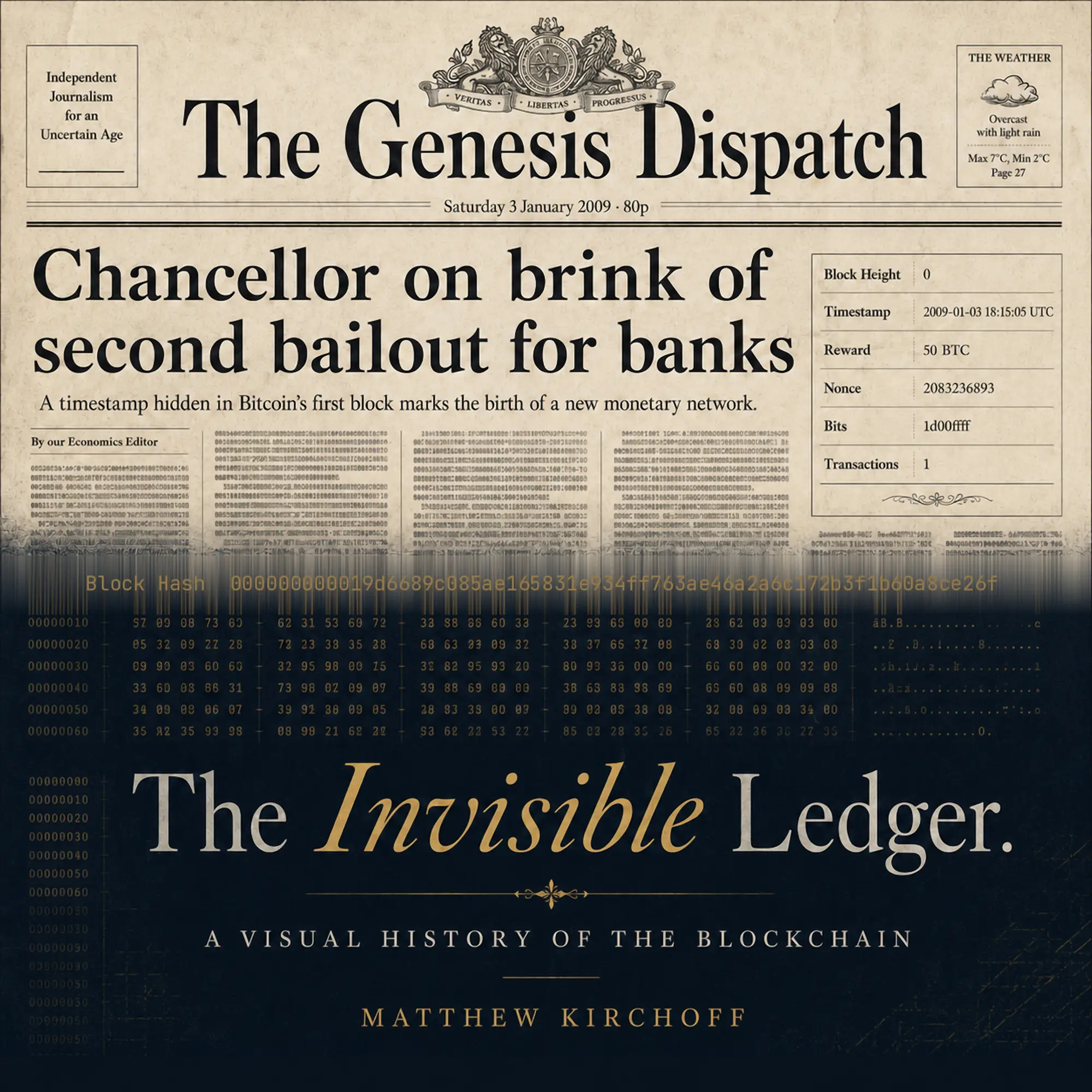
A coffee-table book about the Bitcoin ledger
The Invisible Ledger
Eleven essays and 46 verified artifacts from the chain — the complete story of Bitcoin and its blockchain, printed as a 10″ × 10″ hardcover.
113-page digital edition · 112-page press interior · 46 verified artifacts
The Book
A visual history of Bitcoin, from clay tablets to block 840,000
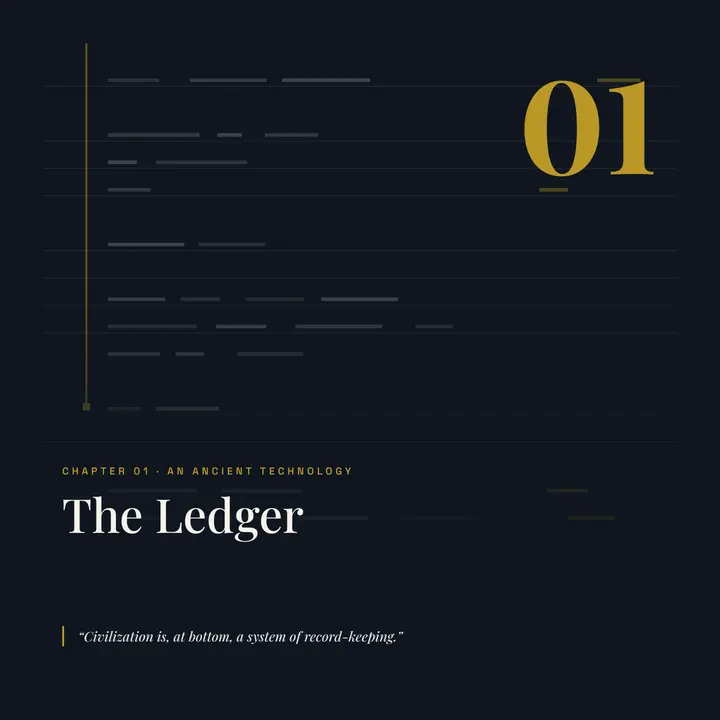
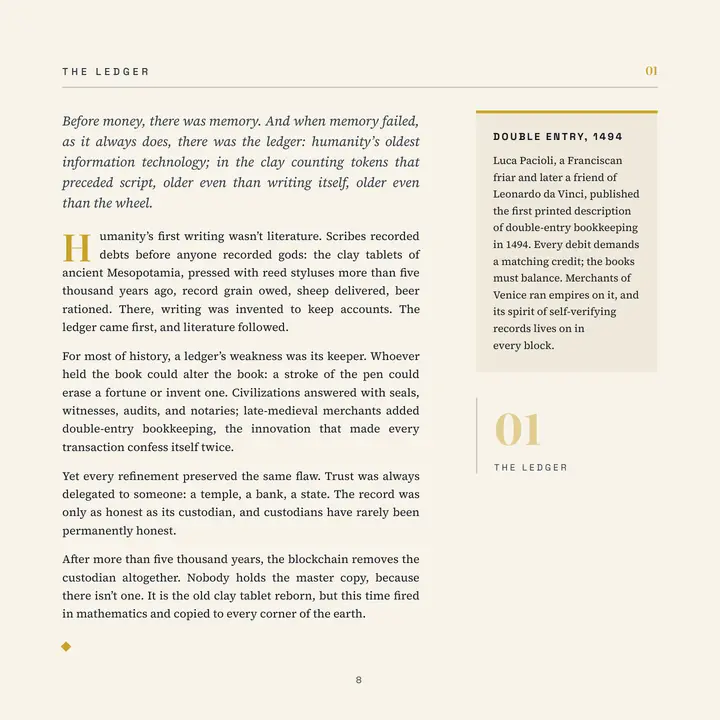
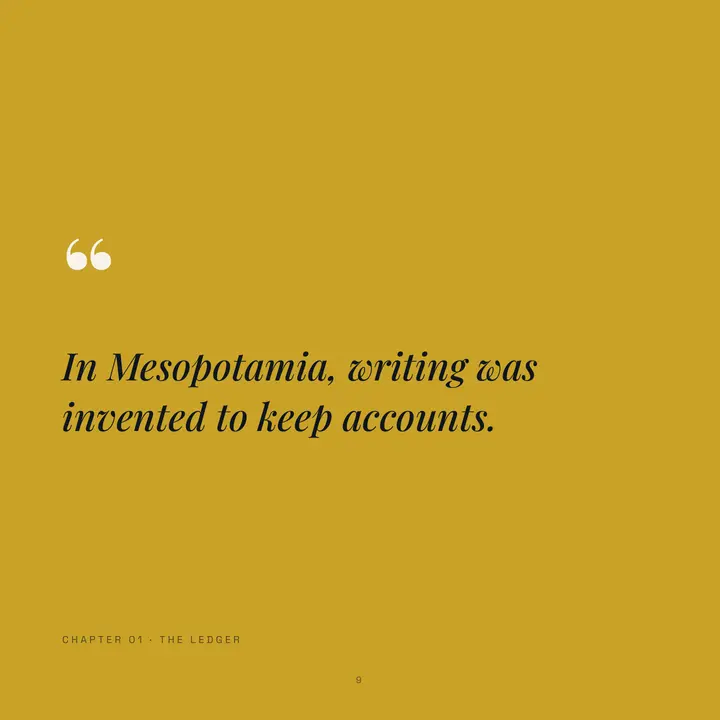
Part One tells the story in eleven essay chapters: the clay-tablet ledgers of Uruk, the cypherpunks, the genesis block, hashes, blocks, chains, mining, keys, smart contracts, proof of stake — an idea with ancient roots and cryptographic branches.
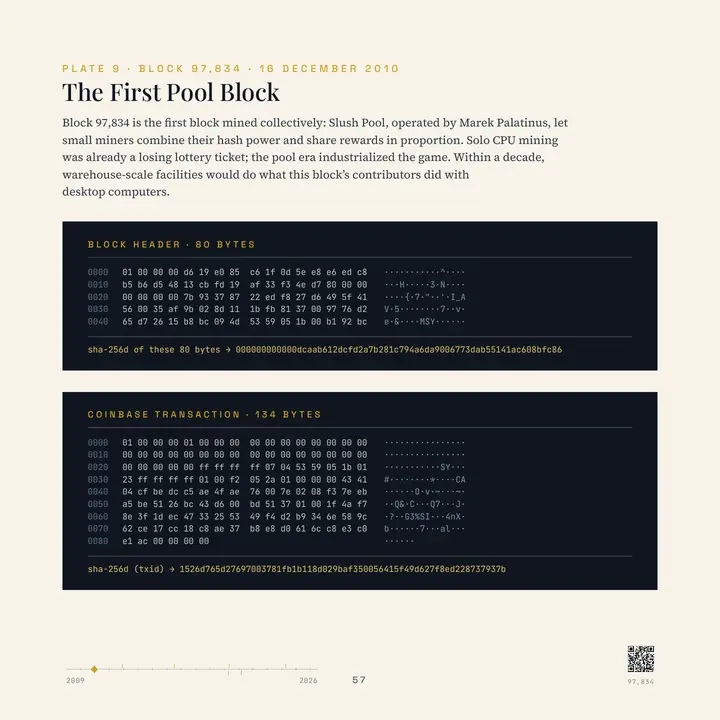
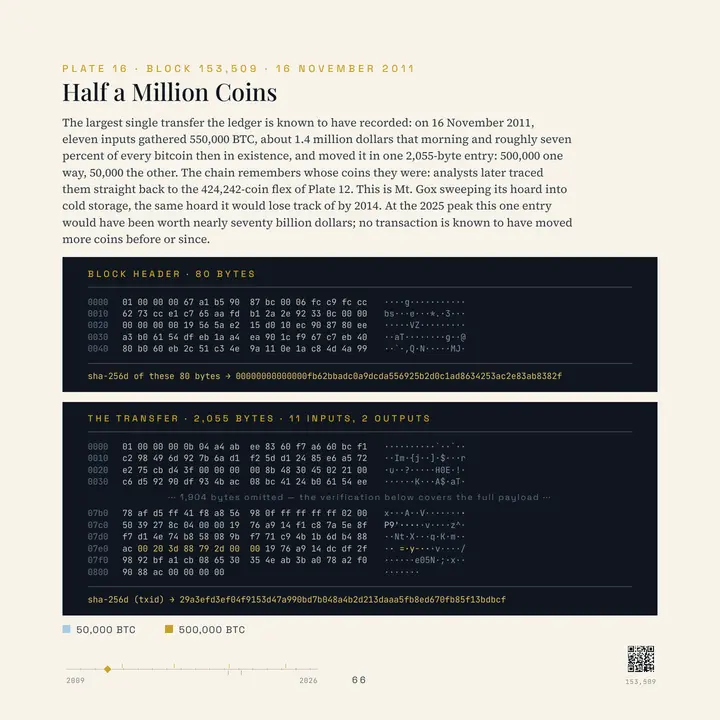
Part Two — The Artifacts reproduces actual chunks of the Bitcoin blockchain byte for byte: 46 verified artifacts from block 0 to block 840,000, paced by full-bleed Block Art pages at the great moments and an ASCII-art gallery decoded from the chain itself.
Not a manual, not a market forecast. A primary-source art book — the blockchain treated as the historical document it already is.
Specifications
- Format
- 254 mm (10″) square, full bleed
- Extent
- 112-page press interior · 113-page digital edition
- Stock
- 157 gsm matte coated art paper
- Verified artifacts
- 46, block 0 → block 840,000
- Type
- Playfair Display · Source Serif 4 · Space Grotesk · JetBrains Mono
- Proof
- Every byte re-verified at every typesetting
✓ if a single byte were wrong, the book does not build
Read it in order, or open it anywhere. Like the ledger it describes, every page carries a trace of the ones that came before.
Inside the Book
Pick it up. Turn the pages.
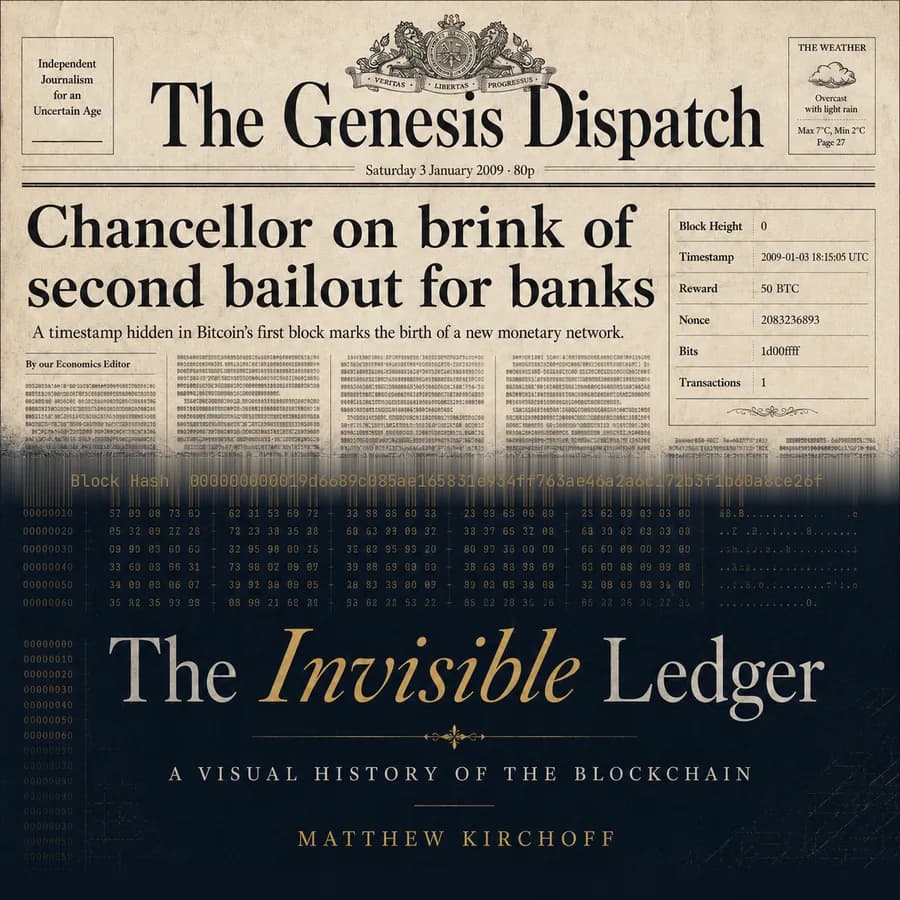
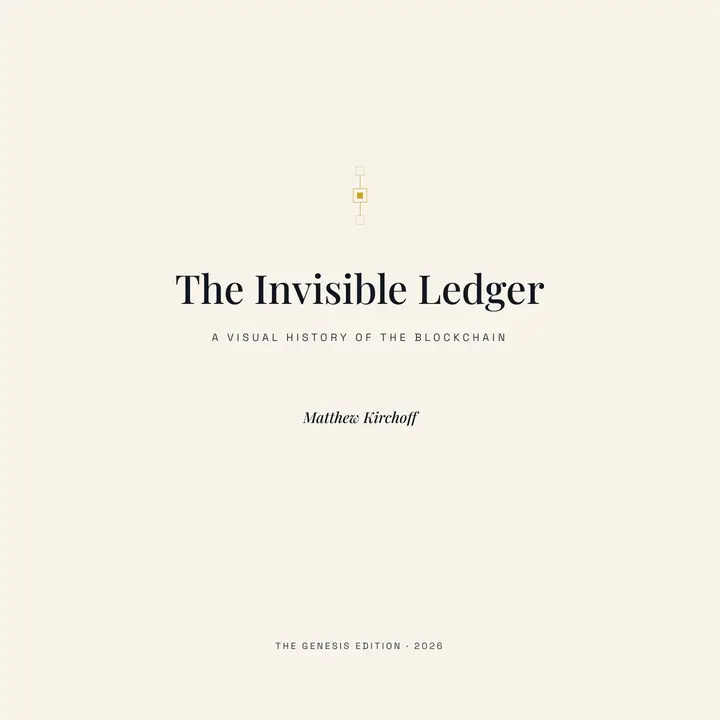
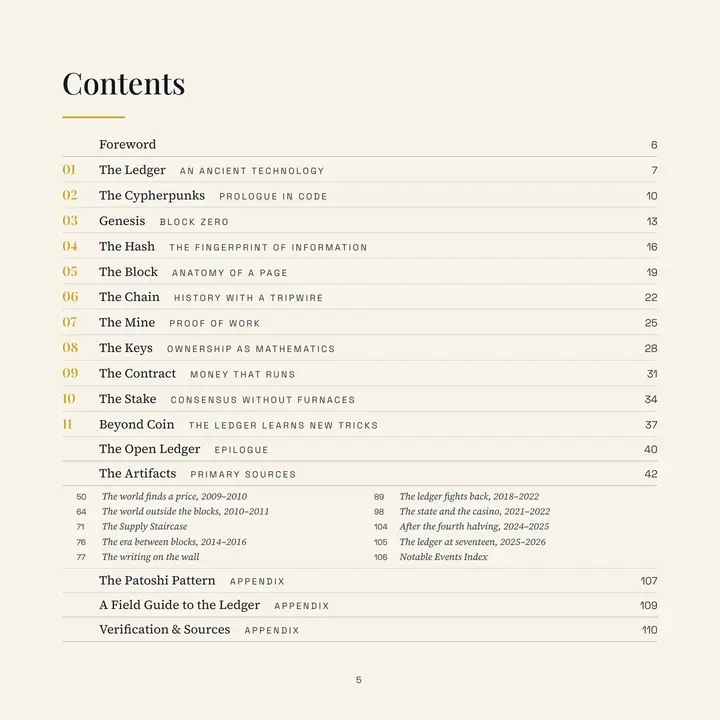
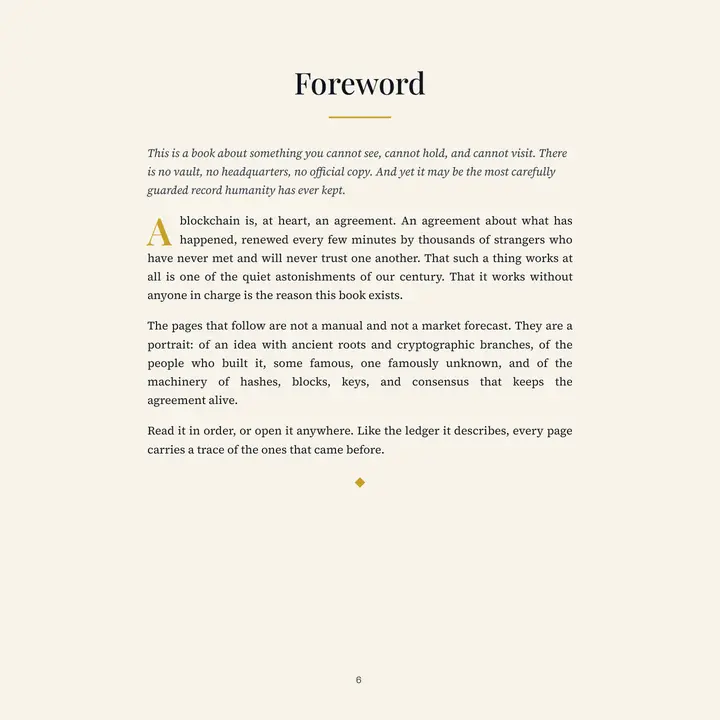
The entire book, cover to colophon — typeset in code, so what you see here is precisely what the press receives. Use the contents to jump anywhere, or read it straight through.

Written in mathematics,
kept by everyone,
owned by no one.
000000000019d6689c085ae165831e934f…
the cover — tap to open
ASCII Art
The Memorial, Decoded
The Len Sassaman tribute · block 138,725
All Glory to the HypnoToad
ASCII art recovered byte-for-byte from the chain
Live Long and Prosper
The Leonard Nimoy tribute, mined into permanence
Spock, in Eighty-Nine Columns
A portrait kept by thousands of strangers, forever
Scroll sideways — like the chain, it keeps going →
Explore the Chain
The book’s machinery, running in your browser
The ideas the book typesets — the tripwire, the hash, the work, and the genesis bytes — exactly as they behave on the real network. Nothing here is simulated.
The Chain · history with a tripwire
go ahead — try to rewrite history
Each block’s fingerprint covers its ledger entries and the fingerprint of the block before it. Edit any entry below — even by one character — and watch the chain react.
Block 0
✗ broken
prev 00000000000000…
hash …
nonce 0
Block 1
✗ broken
prev 00000000000000…
hash …
nonce 0
Block 2
✗ broken
prev 00000000000000…
hash …
nonce 0
Block 3
✗ broken
prev 00000000000000…
hash …
nonce 0
Notice the trap: changing one block broke every block after it, and the cover-up cost real work — at toy difficulty. On the actual network each block takes ~600 quintillion attempts, and honest miners extend the chain faster than any rewriter can chase it. That asymmetry, not secrecy, is what keeps five thousand years of ledger-keeping honest at last.
SHA-256 · The fingerprint of information
computed live in your browser
Change one letter and roughly half the fingerprint changes — the avalanche effect. This is the tripwire that makes the chain’s history tamper-evident: alter any byte in any block, ever, and every fingerprint after it shatters.
Proof of Work · Mine a block
double SHA-256, the real algorithm
A block is sealed by finding a nonce whose fingerprint falls below a target. There is no shortcut — only the lottery. Drag the difficulty up and feel the schedule bite.
header invisibleledger.art|height:953000|prev:00000000…ce26f|nonce:0
hash
The genesis block’s nonce was 2,083,236,893. The network now performs more fingerprints each second than this tab could attempt in a million years — that expenditure, and nothing else, is what a block costs to forge.
Block 0 · raw · 285 bytes · 3 January 2009
tap any field
The message
“The Times 03/Jan/2009 Chancellor on brink of second bailout for banks”
Sixty-nine bytes of ASCII: that morning's front page of The Times, sealed forever into byte zero of the ledger. Proof the block came after that morning — and an epitaph for the system it answered.
✓ sha256d(header) → 000000000019d6689c085ae165831e934ff763ae46a2a6c172b3f1b60a8ce26f
Part Two · The Artifacts
People hid art in the world’s most permanent record
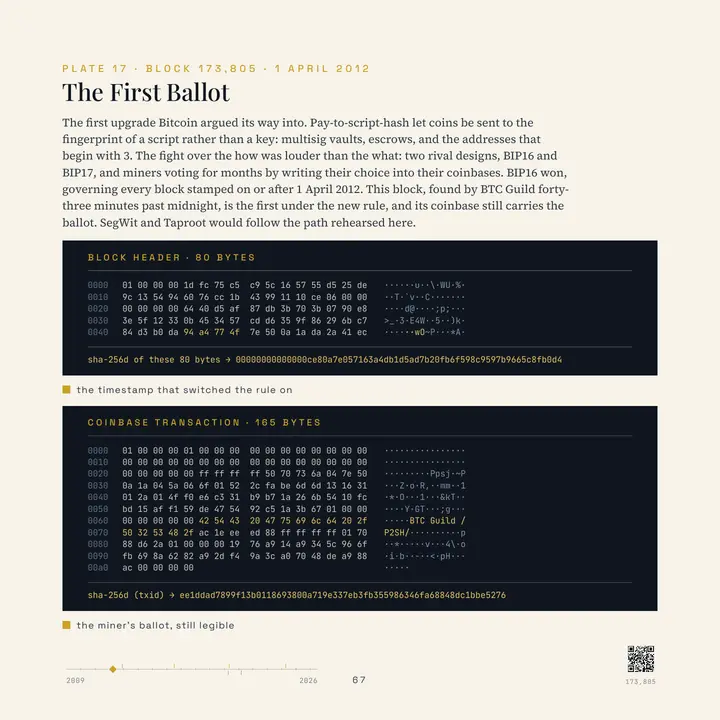
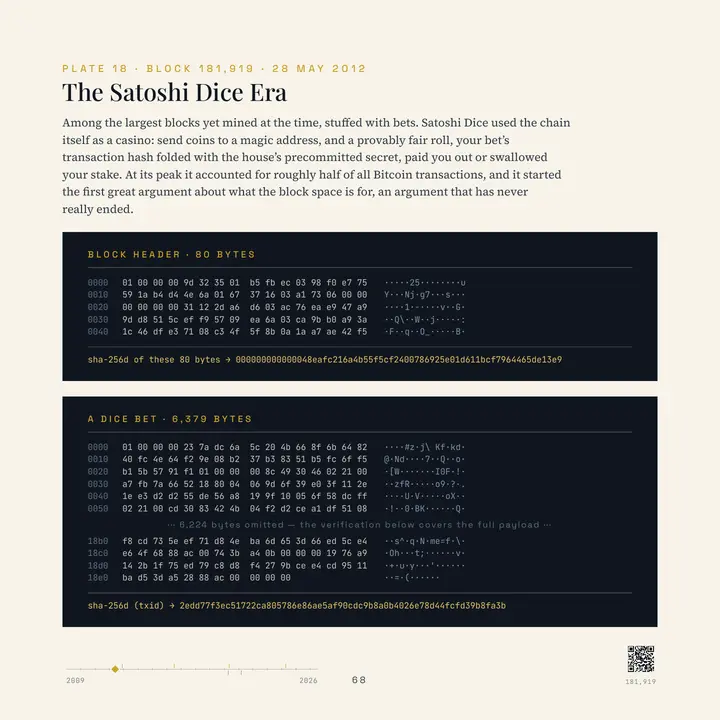
Between 2011 and 2015, people paid real money to seal pictures into the chain — portraits, tributes, jokes. In 2013 someone even embedded Satoshi’s nine-page whitepaper into the system it describes. The book’s gallery decodes these artifacts from raw, merkle-verified transactions; the pieces below come from that same verified pipeline.
The ASCII Art Golden Age · decoded from the chain
decoding from verified bytes…
Appendix · 55,001 early blocks
The Patoshi Pattern: Satoshi’s mining fingerprint
The chart below is built from the book’s own dataset: all 55,001 first blocks, downloaded from the Bitcoin P2P network and merkle-verified, every point a real block.
Every early coinbase carried an ExtraNonce — a counter the mining software incremented as it worked. One machine ran almost without interruption for a year and a half, leaving diagonal stripes whose nonces fall in the restricted ranges Sergio Lerner identified in 2013 as the miner’s signature: the fingerprint of the entity believed to be Satoshi Nakamoto — roughly 22,000 blocks and 1.1 million BTC, untouched to this day.
Don’t trust — verify
If a single byte were wrong, the book does not build
This book is not illustrated with pictures of the blockchain. It is the blockchain — and it holds itself to the chain’s own standard. The typesetting system re-proves every artifact cryptographically each time the book is made; a plate that cannot be verified is a plate that cannot be printed.
check 01
Every header, re-hashed
Each block header in Part Two is double-SHA-256'd against its stated block hash at every typesetting.
check 02
Every artifact, merkle-bound
Gallery pieces carry a merkle path folding their transaction's fingerprint up to a verified header. The art is re-decoded from the verified bytes each build.
check 03
Genesis, reconstructed
Block 0 isn't stored in the book's data at all — it is rebuilt from the protocol specification and must hash to the famous value, or the build stops.
check 04
Dates, sealed
Every printed date must equal the timestamp sealed inside its verified header. The captions cannot drift from the chain.
✓ verified at typesetting — the rule that already removed one fake transaction from this project’s unpublished predecessor
Reservations
Reserve your place in the first printing
Choose an edition and join the reservation list. There is no charge today; we will write once when orders open.
The Digital Edition
The complete book as a print-quality PDF
$21
Launch price · no charge today
- ·All 113 pages at full resolution
- ·Every plate, every verified byte
- ·The complete screen edition
- ·One PDF, readable on every screen
The book itself
The Hardcover
10″ × 10″ · Smyth-sewn case · 157 gsm matte art paper
$120
Launch price · no charge today
- ·112-page press interior, full bleed, lay-flat sewn binding
- ·46 verified blockchain artifacts, byte for byte
- ·Six full-bleed Block Art interstitials
- ·The ASCII gallery & the real Patoshi chart
The Genesis Collector
Signed & numbered — an edition of 210, ever
$210
Launch price · no charge today
an edition of 210 — once they're gone, they're gone
- ·Hand-numbered and signed by the author
- ·Each copy's number printed in its colophon
- ·First printing of the Genesis Edition
- ·210 copies — a nod to the 21 million
Free reservation · no charge today · one email when orders open · the digital edition is included with every physical copy
Questions
Asked and answered
Is this a book about investing?+
No. It is a portrait of an idea and the machinery that keeps it alive — clay tablets to consensus. There is not a price chart in it. It belongs on a coffee table, not a trading desk.
Do I need to understand cryptography to enjoy it?+
Not at all. Part One is written for the curious reader; Part Two is for putting your finger on the real bytes. The book rewards both the casual flip and the deep read.
What makes the plates “verified”?+
The typesetting system re-proves every reproduced byte against the chain's own cryptography — headers re-hashed, transactions merkle-bound, dates checked against sealed timestamps — every single time the book is built. A failed proof stops the press.
Is it a good gift for someone into Bitcoin?+
It was practically designed for that. It is also a good gift from someone into Bitcoin to the people who keep asking them what a blockchain actually is.
What exactly do I get with the digital edition?+
The complete 113-page screen edition as a high-resolution PDF, including every plate and appendix. Delivery details are sent to the email used at checkout when digital orders are open.
When do hardcovers ship?+
Hardcovers are printed in small offset runs. Join the reservation list now; we will send the production schedule and shipping details before asking you to place an order.